Wondering if an ADU could be the smartest way to create more space without giving up your San Jose address? If you need room for family, guests, work, or future rental income, an accessory dwelling unit can open up real options. The key is knowing what an ADU is, what the City of San José allows, and where costs and constraints tend to show up. Let’s dive in.
What an ADU Means in San Jose
An accessory dwelling unit, or ADU, is a self-contained secondary home on a residential property. California Housing and Community Development says an ADU includes permanent facilities for living, sleeping, eating, cooking, and sanitation.
In practical terms, that means the unit functions as its own living space. In San José, ADUs can be built on residentially zoned single-family, duplex, or multifamily properties, while a junior accessory dwelling unit, or JADU, is a smaller unit created within the footprint of a single-family home.
Why San Jose Homeowners Consider ADUs
For many homeowners, an ADU is less about adding square footage and more about adding flexibility. You may want space for extended family, a private guest setup, a quieter work area, or a long-term rental that helps support your household budget.
San José highlights ADUs as a way to create income opportunities and add housing. That makes them appealing if you want your property to serve you in more than one way over time.
Common ADU Types
Detached ADUs
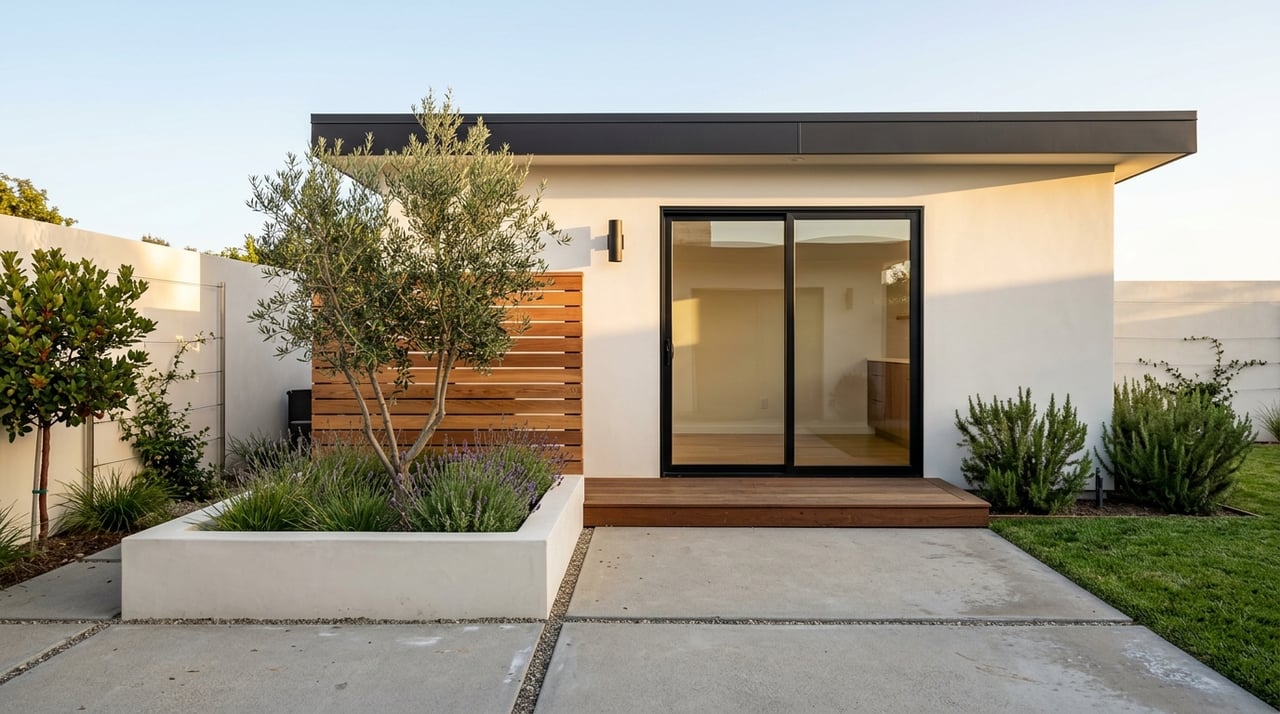
A detached ADU is a separate structure, often built in the backyard. This option usually offers the most privacy because the unit stands apart from the main home.
It can work well if you want a true second living space with some separation. The tradeoff is that detached projects often involve more site planning and construction than a simple conversion.
Attached ADUs
An attached ADU is added onto the main home but has its own independent living facilities. This can be a practical path if your lot layout supports an addition and you want to keep the unit physically connected.
Attached units can sometimes make efficient use of the existing structure. Still, the design has to meet local and state rules for ADUs rather than function like just another bedroom suite.
Converted Space ADUs
Some homeowners create an ADU by converting existing space, such as a garage or basement. This can be attractive when you already have a structure in place and want to avoid a fully new standalone build.
Conversions are often part of the conversation when homeowners want to manage costs and simplify the project scope. Even so, the space still has to meet code and permit requirements.
JADUs and Tiny Homes on Wheels
San José also recognizes JADUs, which are smaller units within the footprint of a single-family home. These are different from full ADUs, including utility requirements in some cases.
The city also treats tiny homes on wheels as a type of ADU and has a separate checklist for them. If you are exploring a less traditional setup, that distinction matters early in the process.
Start With the San Jose Checklist
Before you get too far into design ideas, the City of San José recommends starting with its ADU Universal Checklist. This is the city’s first screening tool, and it helps identify whether your property is a likely fit.
The checklist looks at issues such as whether the property is actually within San José, whether the main home is legally permitted, whether there is an active code enforcement case, and whether hazards or easements affect the site. The city states that an ADU is not allowed if the main residence is not permitted, and active code cases must be resolved before plans are accepted.
What the Approval Process Looks Like
For many homeowners, the good news is that ADU approvals are generally more administrative than negotiable. California HCD says ADUs and JADUs generally must be approved ministerially in residential and mixed-use zones, which means staff-level review rather than a discretionary public hearing.
That creates a process that is more checklist-driven than debate-driven. In San José, the city recommends completing the checklist first, asking for planner feedback if needed, and then preparing formal plans for permit submittal.
If you want early guidance, San José offers a preliminary virtual meeting with a planner. The city lists that service at $398 per hour with a 30-minute minimum.
Key Rules That Shape Your Options
State rules set some important guardrails that can help homeowners understand what cities can and cannot require. According to California HCD, jurisdictions generally may not impose minimum lot-size requirements for ADUs.
HCD also says local rules generally may not require rear and side setbacks greater than four feet for new construction ADUs. In addition, jurisdictions may not require more than one parking space per unit, and certain ADUs may not require parking at all.
Size standards matter too. HCD says jurisdictions may not establish maximum sizes below 850 square feet, or 1,000 square feet for larger one-bedroom-plus units.
For San José homeowners, these state standards help frame what may be possible. Your actual project still depends on your lot, your existing home, and any site-specific constraints.
Preapproved Plans Can Save Time
If speed and simplicity matter, San José’s preapproved ADU program is worth a close look. The city describes these as non-site-specific construction plans that have already been reviewed for code compliance.
When your site-specific documents are complete, preapproved plans can allow same-day permit issuance. San José also says this is intended to be the fastest and lowest-cost permit path.
There is a catch, though. Preapproved plans are limited to residential lots with an existing single-family home or duplex, and they cannot be used on lots in geohazard, landslide, flood, or wildland-urban interface areas.
The city also says homeowners must choose either City development standards or State development standards rather than mix the two. That is an important detail to clarify before you finalize plans.
Costs to Expect Beyond Construction
Many homeowners focus on build cost first, but permit-related costs deserve equal attention. San José provides a building permit fee estimator for ADU projects, and the city’s fee schedule is current as of August 11, 2025.
Depending on the property and project, additional charges may include school fees, parkland impact fees, geologic hazard review, tree removal permits, fire variances, and construction taxes. This is one reason the total cost of an ADU can vary widely from one property to another.
For broader context, a 2021 statewide survey found a median ADU construction cost of $150,000 in California and $177,500 in the San Francisco Bay Area. Those figures are best used as directional benchmarks, not current project quotes.
When Smaller ADUs May Reduce Fees
Size can affect fees in a meaningful way. San José says school and parkland impact fees do not apply to ADUs under 750 square feet.
California HCD adds that jurisdictions may not impose impact fees on ADUs under 750 square feet or on JADUs. For larger ADUs, impact fees may be charged proportionately based on the ADU’s floor area compared with the primary home.
That does not mean smaller is always better. It does mean that if your goals can be met with a more compact layout, the math may look more attractive.
Ongoing Costs After the Build
Your budget should not stop at permits and construction. San José notes that property taxes increase based on the value of the ADU.
Utility planning matters too. The city says PG&E now requires ADUs to have their own meter, while JADUs do not require separate meters because they are not separate units.
These ongoing costs can shape your return on investment and your monthly carrying costs. It is smart to factor them in early rather than treat them as a surprise later.
Can You Rent Out a San Jose ADU?
In many cases, yes. San José says homeowners may rent an ADU to whomever they choose, subject to fair housing rules, and the city notes that the main house and ADU can be rented to different parties.
California HCD says certain ADUs and JADUs generally must have rental terms of more than 30 days. That makes ADUs more aligned with long-term housing than short-term lodging.
If rental income is part of your plan, this is a useful framework. It also reinforces why many homeowners see ADUs as a long-term property strategy rather than a quick side project.
Best Uses for an ADU
In San José, the strongest case for an ADU is often flexibility. The city points to benefits such as more affordable housing, homeowner income opportunity, and infill development.
For you, that can translate into several practical uses:
- Space for multigenerational living
- A private guest or caregiver setup
- A dedicated home office or studio
- Long-term rental income
- A more adaptable property for future life changes
The best use depends on your lot, your budget, and how you plan to live in the property over the next several years. Thinking ahead usually leads to better design decisions now.
How ADUs Fit Into Long-Term Property Value
An ADU is not the right move for every property, but it can change how a home functions and how future buyers view its flexibility. In a market like San José, usable secondary space can stand out when it is permitted, well-planned, and aligned with the property.
If you are weighing an ADU as part of a future sale, hold, or move-up strategy, local context matters. The right approach depends not just on building rules, but also on neighborhood demand, lot characteristics, and your timing.
If you are thinking through whether an ADU makes sense for your property or your next move in San Jose, The Samit Shah Team can help you look at the decision through both a real estate and resale lens.
FAQs
What is an ADU in San Jose?
- An ADU in San José is a self-contained secondary home with permanent living, sleeping, eating, cooking, and sanitation facilities on a residential property.
What is the difference between an ADU and a JADU in San Jose?
- A full ADU is a separate dwelling unit, while a JADU is a smaller unit created within the footprint of a single-family home.
Can you build an ADU on any San Jose property?
- No. San José says the property must meet local eligibility requirements, the main residence must be legally permitted, and active code enforcement issues must be resolved before plans are accepted.
Are preapproved ADU plans available in San Jose?
- Yes. San José offers preapproved ADU plans for certain residential lots with an existing single-family home or duplex, and they can allow same-day permit issuance when site documents are complete.
Do San Jose ADUs have impact fees?
- ADUs under 750 square feet do not have school or parkland impact fees in San José, while larger ADUs may have proportionate impact fees.
Can you rent out an ADU in San Jose?
- Yes. San José says you may rent an ADU subject to fair housing rules, and certain ADUs and JADUs generally must be rented for terms longer than 30 days.
Do ADUs in San Jose require separate utility meters?
- San José says PG&E requires ADUs to have their own meter, while JADUs do not require separate meters.
How much does an ADU cost in the Bay Area?
- A 2021 survey found a median ADU construction cost of $177,500 in the San Francisco Bay Area, but that figure is best treated as a directional benchmark rather than a current quote.